
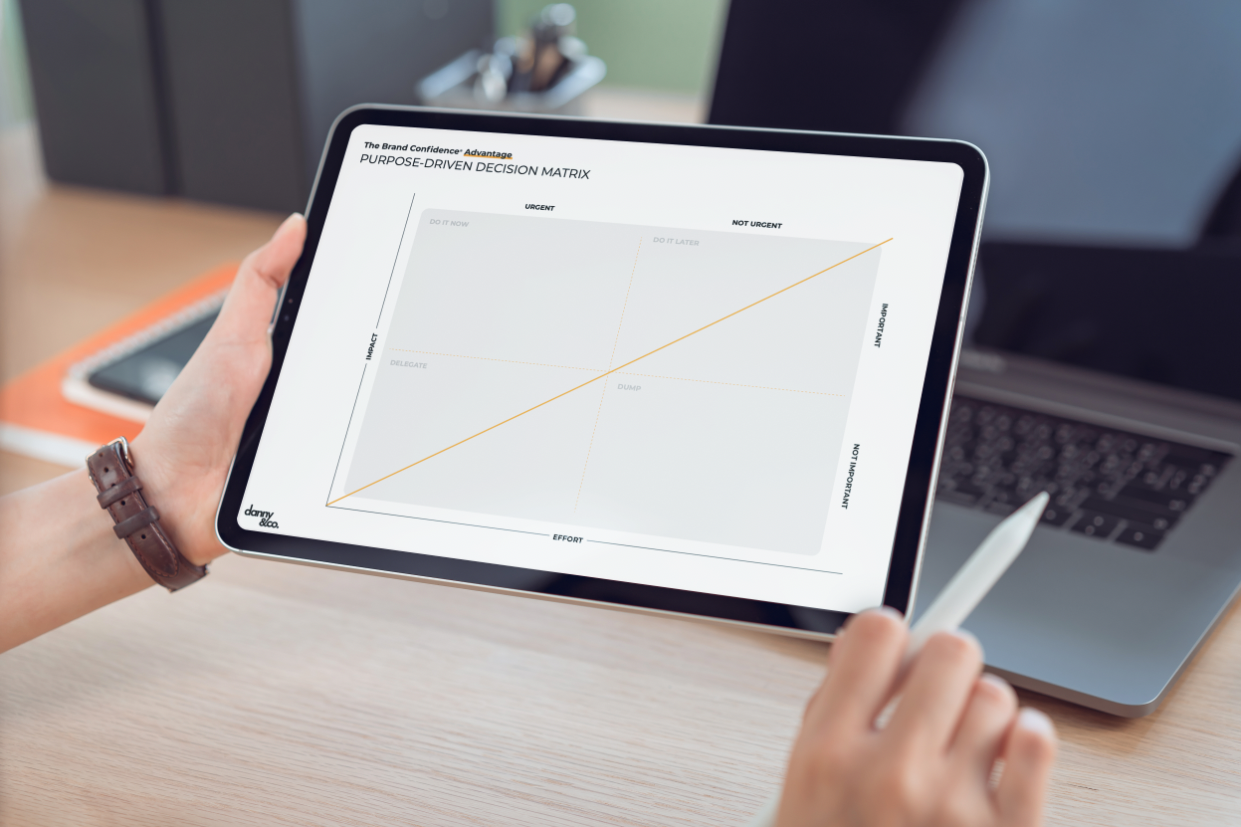
For most small business owners our intention is to build a profitable and fulfilling business, where we can eventually remove ourselves from the day-to-day operations to focus on the high-level strategy that will move the business forward, not to mention the desire for a better work-life balance.
So what goes wrong?
Gradually, and mainly due to time constraints, we become reactive to the market which keeps us from the growth that was originally intended.
Operations continue, but soon enough uncertainty rules our decision making. And nothing changes.
Until we change. Until you change.
This is the difference between working ‘IN’ your business and ‘ON’ your business – doing the urgent but sometimes unimportant tasks and never getting the time to work on the important but less pressing things we know will move us closer to our goals.
Branding all too often falls into that category. You know you need to invest in branding, but do you have the time or the energy or the confidence?
Here are the three steps we use help clients through (in other to words, the strategy) and transform them from uncertain operator to confident leader. Then they have the time, energy and determination to drive the business forward. Branding and all those other ‘important but less pressing’ essentials can rise to the top of the ‘to do’ list.
1. SET INTENT
Setting – or equally resetting – your intent will help you re-establish your goals for your business, your life and your family.
Goals
We recommend you do this in a number of ways, starting with making a list of some high-level goals you want to achieve over the next three years, one year and three months.
You can include here your professional, personal, financial, fitness, health, family and relationship goals. Your level of performance relies on all of these areas.
Vision Planning
You made front page news! Imagine you pick up a newspaper (if they even exist in ten years) and you’re on the front cover – what does it say?
Write it down. No rules. No wrong answers.
Visualising
Visualising what you want your life and business to look like, we have found to be a powerful tool for setting our intent. Imagine what your perfect day would look like and write it down; tell the story of what happens on your perfect day in as little or as much detail as you like.
Similarly, planning what your perfect week looks like is a good way of deciding in the not too distant future what to dedicate your valuable time to. Just by blocking the time to do the important tasks in life and business can give you a good amount of direction as to what you should be doing now, later and tomorrow.
2. DEFINE PURPOSE
Purpose can sometimes feel overwhelming, as if there is an expectation to be some kind of oracle of your own life.
Discovering a purpose for you and your business is a process. We can guide you. But remember that it is not a destination so sometimes it can help by taking smaller steps in the process first.
Purpose can be defines as the answer to the question: “Why do we exists, above making money or profit?”
RELATED: ‘Start With Why’ by Simon Sinek [VIDEO]
If that seems too far away right now try these steps.
Values
Values are a simple way to get started. Write down a list of values that you and/or your business have and then split them into two groups; the values you demonstrate through actions and behaviours and the values you aspire to be known for.
Remember that it may be nice to tell people that you are personal and compassionate, but if most of your communication is via email people will feel a disconnect between what you say and what you do.
Ikigai
Another way to start to find purpose is through the Japanese method of Ikigai, meaning ‘a reason for being’.
Ikigai is a method used to combine your vocation, mission, passion and profession through the intersections of what you love, what you can be paid for, what you are good at and what the world needs. This can be a powerful exercise and is exactly how Danny&co. started.
UN Global Goals
If you still feel stuck on a direction of your purpose, the UN has global goals for sustainable development which can help give you a kickstart to discussing and reflecting on what you care about.
Think about each area and whether it relates to your past, your experience history or another event in life you can connect with on an emotional level.
3. IDENTIFY MARKET
Identifying your market means understanding your clients and customers, your competition and even potential partners to find out where you might be positioned. Here you will go from being unclear about your audience and competitors to having a clear view of your own market position.
Your ideal client
The term ‘ideal client’ has become something of a cliché over the last decade, but for good reason. As the internet opened our eyes to the global market we can operate in, digital and social media have given us a wide playing field.
This means that access to a global market is easier than ever but requires the financial investment to succeed.
Narrow focus
Having a narrow focus not only helps us tailor our message easily with more understanding, it significantly reduces the investment needed to market and sell. Start to think about who your ideal client is and how they operate in their day-to-day – the more information the better.
If you find you have multiple client types try splitting them into two or three types and write down what each of their main pain points or problem is, if you are best placed to help them and if they are best placed to pay you for it. This process of elimination will help you decide where to go first.
You may also want to put together a checklist of your perfect client; what characteristics, problems and traits do they have which align with your values and beliefs?
Your positioning statement
Your positioning statement is a great tool to use early in the branding process to start understanding how you communicate what you do and how you do it for your ideal client in a simple and easy to understand way.
It is the defining answer to “What do you do?” and gives a compelling selling point and reason to buy rolled into one. Simple, clear and concise.
This is something you will change and build on over time as you understand your market better and better, but for now will give you a clear line of sight.
These three steps are just a flavour of the journey we take our clients on, and which helps them not just in the branding process but in all areas of business. If you’d like to talk to us about training on how to make better decisions faster as a purpose-driven leader, we would love to hear from you.